About
Welcome to BirdsOfNC.org! I’m Michael Erb, a North Carolina birder. On this website, I’ve started to catalog some of the common (and not so common) birds of NC, to provide an easy visual reference for other birders.
I’m based in western NC, so the site may have a western focus for now. Ultimately, I’d like to find and photograph all of the most common birds in the state. All of the photos on this site show wild birds living in North Carolina.
Have comments, questions, or suggestions? Spot any errors? Reach out using the form at the bottom of this page!
How is bird “commonness” decided?
What are the most common birds in North Carolina? Foolishly, I thought this would be an easy question to answer. But first of all, what do we mean by commonness? Most birds by population? Most frequently seen birds? What if some birds live in cities and others are remote? What ifs some are common in summer and rare in winter?
As a first attempt to answer this question, I downloaded statewide data from eBird from the past 10 years, which you can find here: https://ebird.org/barchart?byr=2016&eyr=2025&bmo=1&emo=12&r=US-NC. The dataset provides a “frequency” metric, which records how often birders saw a particular species on birding trips. For the overall rankings of birds, I averaged the monthly data for the entire year to compute an single “frequency” metric for each bird. For the range maps, I use county-specific data averaged over the year. On the maps, a medium blue represents a frequency of 0.5, meaning that half of all birders saw the bird on their trip (a very common bird!), and white (frequency = 0) means that none did. Bar charts use state-wide data averaged into monthly values.
However! This data isn’t perfect. Birders are seemingly more likely to record easily-recognizable, charismatic birds like the Northern Cardinal and Blue Jay, and might overlook or ignore “plain” birds like the House Finch or House Sparrow. In the future, I plan to explore more data from the Breeding Bird Survey or Christmas Bird Count, which are probably better estimates of bird populations.
Have other suggestions for computing a “commonness” metric? Contact me below!
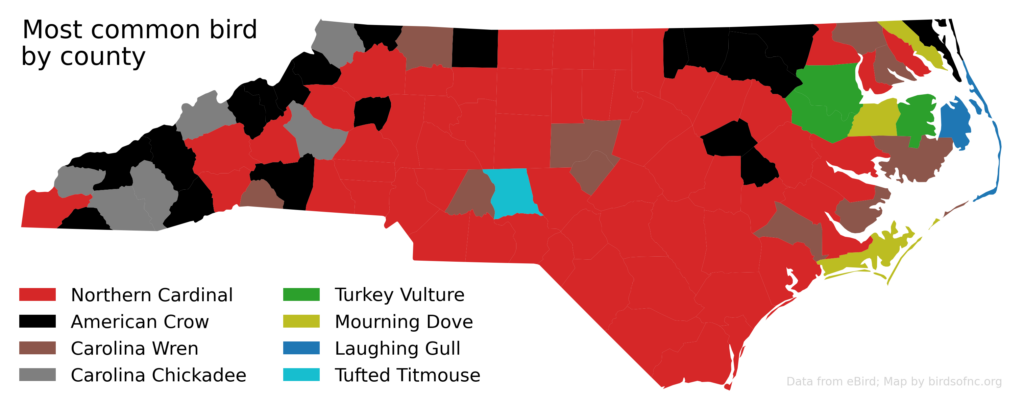
For fun, I’ve applied this metric to each county, so you can see the most commonly reported bird across the state. For most counties, it’s the Northern Cardinal, our state bird!
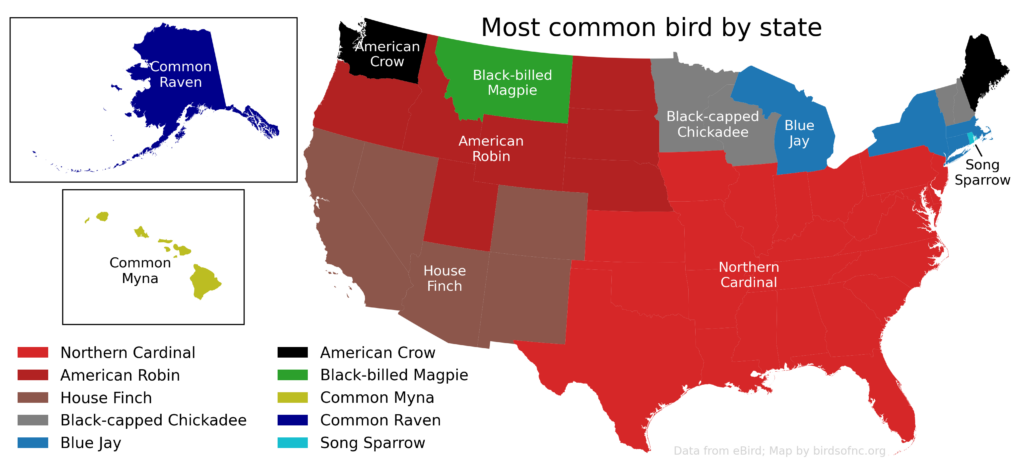
Here’s the same approach applied to state data across the U.S.:
Data Sources
The numeric data on this site, which underlies the bird rankings, maps, and bar charts, come from eBird:
- eBird. 2021. eBird: An online database of bird distribution and abundance [web application]. eBird, Cornell Lab of Ornithology, Ithaca, New York. Available: http://www.ebird.org. (Accessed: June 27, 2026)
Many resources and people helped inform the bird information on this site. A big thanks to all of those resources, particularly the following (coming soon!).
Contact
This website is a personal project, and is not associated with the creator’s primary employment.